London's contemporary galleries - a member's guide to the ones worth the walk
Commercial galleries, kunsthalles and project spaces: where to see new work in London for free.
London's contemporary art landscape offers diverse experiences, from publicly funded institutions like Serpentine and Whitechapel, focusing on artistic development and public engagement, to commercial powerhouses such as White Cube and Hauser & Wirth, which represent artists and drive the art market. Understanding their distinct missions enhances any visit. London's contemporary art scene stands as a dynamic global hub, a place where established institutions and cutting-edge commercial spaces coexist, each contributing uniquely to the cultural dialogue. For anyone seeking to understand the pulse of current artistic practice, navigating these galleries reveals a spectrum of curatorial approaches, architectural styles, and artistic ambitions. This guide provides an overview of some key players, offering insights into their programs and the character of their spaces.
Publicly Funded vs. Commercial Galleries
A common point of confusion for visitors is the distinction between publicly funded and commercial art galleries, especially since both are typically free to enter. Their operational models and underlying missions differ significantly.
Publicly funded galleries, such as the Serpentine Galleries, Whitechapel Gallery, Camden Art Centre, and South London Gallery, receive financial support from government bodies like Arts Council England and the National Lottery Heritage Fund, as well as from trusts, foundations, and individual donations. For instance, the Foyle Foundation has been a significant supporter of various cultural institutions, including the Whitechapel Gallery. Their primary mission involves public education, artistic development, and cultural enrichment. They often commission new work, host educational programs, and aim to make art accessible to a broad audience without the direct pressure of sales. While they might have archives or study collections, they generally do not hold permanent art collections in the way a museum does, instead focusing on a rotating schedule of temporary exhibitions. Free entry aligns with their public service mandate, fostering wider engagement with contemporary art.
Commercial galleries, including White Cube, Hauser & Wirth, and Sadie Coles HQ, operate as businesses. They represent artists, promoting their careers and selling their artworks to private collectors, institutions, and corporations. Their revenue comes directly from art sales, taking a commission on each transaction. Beyond exhibitions, these galleries often invest in artist career management, including facilitating museum shows, producing scholarly catalogues, and strategically positioning artists within the global art market. For example, White Cube's representation of Tracey Emin and Damien Hirst has been instrumental in shaping their international careers, while Hauser & Wirth manages the estates of major figures like Louise Bourgeois and Philip Guston, ensuring their legacies. Exhibitions in commercial spaces serve as showcases for their represented artists, designed to attract buyers and generate market interest. While they offer free entry, this is part of their business model- it allows potential clients and the wider public to view the art and engage with the gallery's program. These galleries are often global enterprises, with multiple locations in major art markets worldwide, from New York to Hong Kong.
Serpentine Galleries
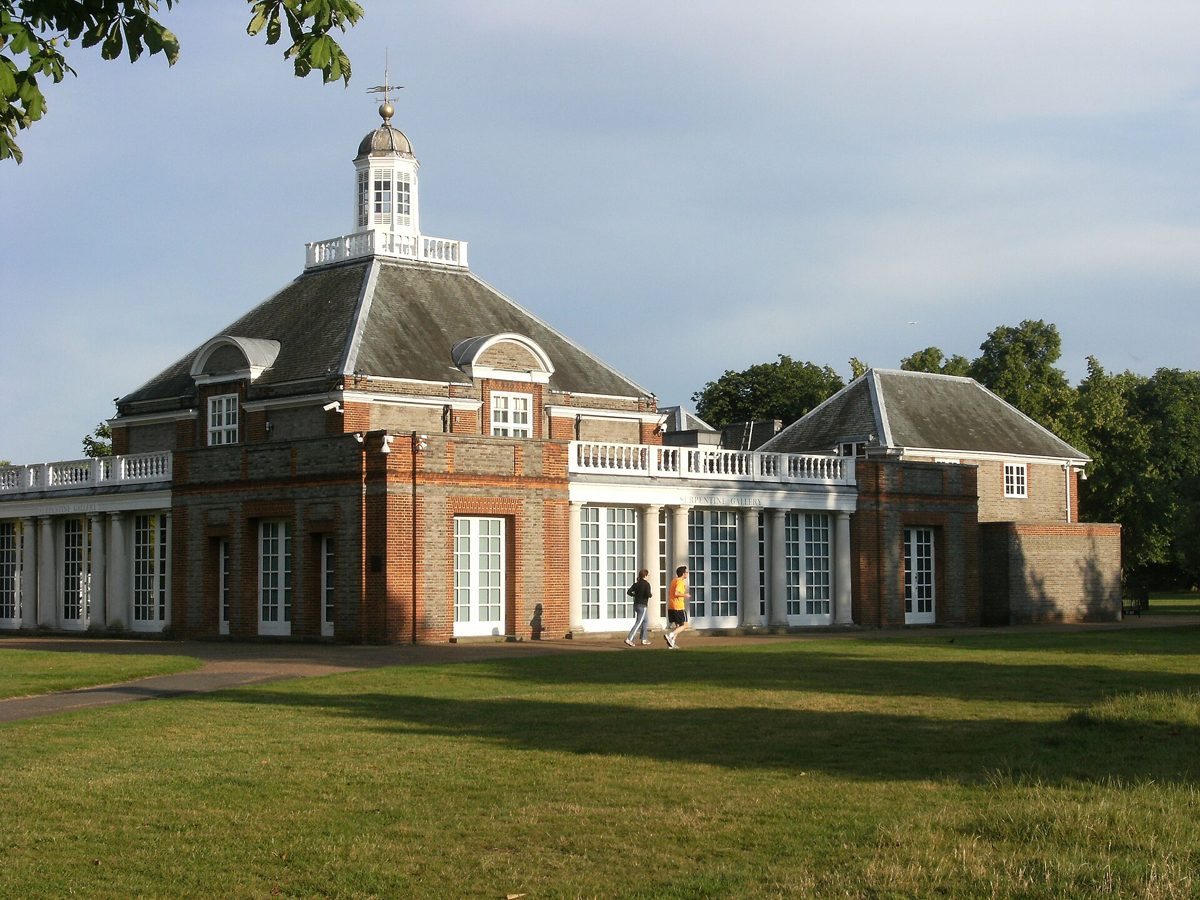
Located in Kensington Gardens, the Serpentine Galleries consist of two distinct spaces- the Serpentine Gallery and the Serpentine North Gallery- separated by the Serpentine Lake. This unique setting influences their program, which often engages with nature, architecture, and public space, blurring the lines between art, design, and the environment.
The Serpentine's program is known for its commitment to contemporary and modern art, frequently showcasing international artists, often with an experimental edge. They have a history of presenting significant first UK solo exhibitions for artists who later achieved global recognition, such as Christo and Jeanne-Claude's The Mastaba in 1970, Anish Kapoor's early monumental sculptures, and Wolfgang Tillmans's photographic explorations. A distinctive feature is the annual Serpentine Pavilion, a temporary architectural commission by an international architect or design studio that has not previously built in the UK. This structure becomes a public space and event venue for the summer, demonstrating a fusion of art and architecture. Notable pavilions include Zaha Hadid's inaugural design in 2000, Bjarke Ingels's "unzipped wall" in 2016, and Frida Escobedo's reflective patio in 2018, each offering unique public interactions and design innovations.
The Serpentine Gallery, housed in a classical 1934 tea pavilion, offers a traditional, light-filled exhibition space with high ceilings and a sense of calm, ideal for focused presentations. The Serpentine North Gallery, a former gunpowder magazine built in 1805, provides a more industrial, flexible environment, allowing for larger-scale installations and diverse media, such as James Turrell's immersive light environments or Marina Abramović's durational performances. Together, they offer contrasting yet complementary backdrops for contemporary art, inviting artists to respond to their unique architectural and natural surroundings.
Whitechapel Gallery
The Whitechapel Gallery, situated in London's vibrant East End, boasts a long and pioneering history, having been established in 1901 to bring great art to the people of East London. Its program reflects this enduring commitment to accessibility and innovation, often exploring social and political themes relevant to its diverse community.
The gallery has a distinguished record of introducing world-class artists to the UK, including early exhibitions of Pablo Picasso's Guernica in 1939, Jackson Pollock in 1958, and Mark Rothko's first UK show in 1961. These groundbreaking shows cemented its reputation as a vital cultural gateway. Today, its program continues to focus on commissioning and presenting major works by international contemporary artists, often with a strong social or political dimension. Recent exhibitions have featured artists like Michael Rakowitz, whose work The Invisible Enemy Should Not Exist (2007-ongoing) recreates lost Iraqi artifacts, and Nalini Malani, known for her powerful video and shadow play installations exploring migration and conflict. The Whitechapel also dedicates space to its extensive archives, offering insights into its rich past and the history of modern art, including documents related to the Independent Group, Pop Art, and early feminist art movements. Education and community engagement remain central to its mission, with a robust schedule of talks, workshops, and family events, ensuring art remains accessible and relevant to all ages.
The character of the Whitechapel's space is a compelling blend of historic charm and modern functionality. Its original Arts and Crafts facade leads into a multi-level interior that combines grand, traditional gallery rooms with more contemporary, adaptable spaces. The building underwent a significant expansion in 2009, integrating the former public library next door and adding new galleries, an auditorium, and an expanded bookshop, creating a comprehensive cultural hub that respects its architectural heritage while providing state-of-the-art facilities for contemporary art.
White Cube
White Cube stands as a leading commercial gallery, representing some of the most influential artists of our time. Founded by Jay Jopling in 1993, it became synonymous with the Young British Artists (YBAs) in the 1990s, playing a pivotal role in launching careers and shaping the global art market.
White Cube's program features a roster of established and emerging artists, known for often challenging and large-scale works across various media, including painting, sculpture, installation, and video. The gallery's exhibitions are meticulously curated, aiming to present significant new bodies of work that contribute to contemporary artistic discourse. Artists like Tracey Emin, with her deeply personal installations, and Damien Hirst, known for his provocative conceptual works, have been central to the gallery's identity. Its global presence and strong market positioning mean its shows often attract considerable attention from collectors and critics alike, frequently selling out before opening to the public.
The gallery operates multiple spaces in London, each with a distinct character. White Cube Bermondsey is its largest and most ambitious, a vast, industrial-scale space purpose-built in a former 1970s warehouse. Its sheer size, spanning over 54,000 square feet, allows for monumental installations and ambitious projects that few other London galleries can accommodate, such as Anselm Kiefer's epic paintings or Theaster Gates's multi-disciplinary social practice works. White Cube Mason's Yard, located in Mayfair, offers a more intimate yet equally sleek experience. Designed by MRJ Architects, it features characteristic white cube aesthetics and provides a refined setting for showcasing contemporary art in a central, upscale location, often presenting more focused solo shows by artists like Sarah Morris or Harland Miller.
Hauser & Wirth
Hauser & Wirth is a globally recognized commercial gallery with a significant presence in London, known for its museum-quality exhibitions and extensive artist representation, bridging historical legacies with contemporary innovation.
The gallery's program is broad, encompassing modern masters and a diverse range of contemporary artists. They represent estates of historically significant artists like Louise Bourgeois and Philip Guston, alongside a roster of leading contemporary figures such as Roni Horn, Mark Bradford, and Pipilotti Rist. Hauser & Wirth often curates exhibitions that explore historical dialogues or present groundbreaking new work, distinguished by a scholarly approach, frequently accompanied by substantial, richly illustrated publications and academic symposia. Their shows frequently feature a high level of production and ambitious installations, transforming their spaces into immersive artistic environments.
In London, Hauser & Wirth's flagship space on Savile Row is particularly notable. It occupies a beautiful Georgian townhouse, blending heritage architecture with contemporary gallery design across multiple floors. The multi-floor layout offers a variety of exhibition environments, from grand, naturally lit rooms perfect for large-scale paintings or sculptures, to more focused, intimate spaces suited for delicate works on paper or video installations. This blend allows for diverse presentations, all within an elegant and refined setting that reflects the gallery's international standing and its commitment to presenting art with gravitas.
Sadie Coles HQ
Sadie Coles HQ is a prominent commercial gallery, established by Sadie Coles in 1997, and has been a significant force in the London contemporary art scene, particularly known for its association with the YBA generation and subsequent cutting-edge artists.
The gallery's program focuses intensely on contemporary art, representing a roster of influential British and international artists. Sadie Coles HQ is known for its sharp curatorial vision, often presenting challenging, intellectually rigorous, and visually striking exhibitions. The gallery has consistently supported artists who push boundaries, working across painting, sculpture, photography, video, and installation. Key artists represented include Sarah Lucas, Helen Marten, and Jordan Wolfson, whose works frequently provoke thought and challenge conventional aesthetics. Its exhibitions often highlight new developments in contemporary art and contribute to critical discussions within the art world, solidifying its reputation as a tastemaker.
Sadie Coles HQ typically operates multiple spaces in Mayfair, each characterized by a sleek, minimalist aesthetic. These classic white cube environments are designed to be adaptable and allow the artworks to take center stage without distraction. The varying sizes and configurations of their spaces enable them to present a range of projects, from focused solo shows by artists like Laura Owens to more expansive group exhibitions that explore specific themes, maintaining a consistent brand identity of sophisticated contemporary display that prioritizes the artist's vision.
Camden Art Centre
Camden Art Centre is a publicly funded, non-collecting contemporary art gallery, artist residency, and education center located in North London. Its mission is deeply rooted in supporting artists and fostering public engagement with contemporary art, often through a process-oriented approach.
Its program is distinguished by a commitment to international contemporary art, with a particular emphasis on commissioning new work and supporting artists at various stages of their careers. Camden Art Centre hosts a renowned artist-in-residence program, providing space and resources for artists to develop new projects, which often culminate in exhibitions. For example, artists like Lucy Skaer and Phyllida Barlow have had significant residencies and exhibitions here, showcasing new directions in their practice. The center also has a strong focus on ceramics, with dedicated studios and an ongoing program exploring the medium's contemporary relevance through workshops and exhibitions. Education and community outreach are integral, offering a wide array of courses, workshops, and events for all ages, from children's art classes to adult pottery sessions.
The character of Camden Art Centre's space is unique. Housed in a former Victorian public library, it possesses a more intimate, almost domestic, feel compared to many large, industrial-scale galleries. The building retains many of its original architectural features, such as ornate ceilings and fireplaces, creating a warm and inviting atmosphere. It includes several distinct exhibition spaces, artist studios, a well-stocked bookshop, and a charming walled garden, which often hosts outdoor installations, performances, and community events, blending art with a sense of place and local community.
South London Gallery
The South London Gallery (SLG) is a publicly funded institution with a long history, dating back to 1891, dedicated to presenting international contemporary art and engaging with its local community in Southwark.
The SLG's program focuses on presenting significant solo exhibitions by established and emerging artists, alongside group shows that explore timely themes. It has a strong reputation for commissioning new work and supporting artists who are often underrepresented in mainstream institutions. Recent exhibitions have featured thought-provoking artists like Lawrence Abu Hamdan, known for his investigations into sound and its political implications, and Kapwani Kiwanga, whose work explores power structures and their legacies. Community and education programs are central to its ethos, with extensive activities for local residents, schools, and young people, emphasizing accessibility and participation. The "Art Assassins" youth program, for instance, offers young people opportunities to engage deeply with art and curatorial practice. The SLG also manages two community gardens- the Orozco Garden and the Fox Garden- integrating art with urban green spaces and providing a tranquil retreat.
The gallery occupies a beautiful Victorian building, which has been thoughtfully extended and renovated. The main exhibition spaces feature high ceilings, large windows, and original architectural details, providing a classic yet versatile backdrop for contemporary art. The SLG has expanded into a former fire station next door, adding further exhibition spaces, an education studio, and an archive, significantly increasing its capacity for programming. This combination of historic grandeur and modern functionality, coupled with its engaging garden spaces, gives the South London Gallery a distinctive character that feels both grand and welcoming, deeply embedded in its local environment.
Snapshot of London's Premier Contemporary Art Galleries
To help navigate London's diverse art scene, here's a quick overview of key characteristics for some leading institutions: Serpentine Galleries: Experimental, architectural focus, often engages with nature. Known for annual Pavilions and early career shows for international artists. Whitechapel Gallery: Historic institution in East London. Strong on social/political themes, historical context, and community engagement. Introduced major modern artists to the UK. White Cube: Commercial powerhouse, synonymous with YBAs. Represents market-leading artists, known for large-scale, ambitious exhibitions in vast spaces like Bermondsey. Hauser & Wirth: Global commercial gallery with museum-quality shows. Represents modern masters' estates and diverse contemporary artists. Known for scholarly publications and elegant Savile Row space. Sadie Coles HQ: Influential commercial gallery. Known for supporting cutting-edge, intellectually rigorous contemporary art and YBA artists in sleek Mayfair spaces. Camden Art Centre: Publicly funded, non-collecting. Focus on artist residencies, commissioning new work, and ceramics. Intimate, community-focused in a historic building with a garden. South London Gallery: Publicly funded with a long history. Strong emphasis on international contemporary art, community engagement in Southwark, and integrating art with urban green spaces.
Frequently asked questions
Why are most London galleries free to enter?
Most London art galleries, whether publicly funded or commercial, offer free entry. Publicly funded institutions like the Serpentine and Whitechapel are supported by grants and donations, making public access central to their mission of cultural enrichment. Commercial galleries, such as White Cube and Hauser & Wirth, operate on a business model where art sales generate revenue; exhibitions serve as a vital marketing tool to showcase artworks to potential buyers, making free public access beneficial for their operations and market reach.
How do I choose which gallery to visit?
Choosing a gallery depends on your interests. For experimental and architectural projects, the Serpentine Galleries are excellent. If you appreciate historical context and socially engaged art, the Whitechapel Gallery offers a rich experience. For market-leading contemporary art and large-scale installations, White Cube and Hauser & Wirth are key. For a more intimate, community-focused approach to international contemporary art, Camden Art Centre and the South London Gallery provide unique perspectives. Checking their current exhibition programs online is always the best way to plan your visit, allowing you to tailor your experience to specific artists or themes.
Do these galleries have permanent collections?
Generally, the publicly funded institutions listed here- Serpentine, Whitechapel, Camden Art Centre, and South London Gallery- primarily focus on temporary exhibitions rather than maintaining a permanent art collection in the traditional museum sense. They may have archives or study collections, but their main purpose is to present new and touring shows, fostering dynamic engagement with contemporary practice. Commercial galleries like White Cube, Hauser & Wirth, and Sadie Coles HQ do not have permanent collections; they represent artists and hold inventory for sale, curating shows to highlight these works and facilitate their sale to collectors and institutions worldwide.
This is an independent member's guide compiled by London BGTC Society. We are not affiliated with the venues and institutions mentioned; opening arrangements and programmes change - always confirm details on the official websites before making plans.
← Back to Events