London's best parks and gardens - a member's guide
From royal parks to hidden garden squares - where Londoners actually go for green space, and when each park is at its best.
London keeps roughly 3,000 parks and open spaces, a green inheritance that shapes how the city breathes, moves, and unwinds. Some are royal hunting grounds repurposed for deckchairs and pedalos. Others are medieval commons that survived enclosure by sheer public stubbornness. This guide covers the ones that matter most to Londoners, not just visitors, with notes on when to go, what to do, and the quiet corners the crowds miss.
Hyde Park
Hyde Park is London's loudest green space, a 142-hectare rectangle of old oaks, manicured lawns, and relentless human activity. It was Henry VIII's deer park before Charles I opened it to the public in 1637, making it one of the oldest public parks in Europe.
Best for: People-watching, protest culture, and the sheer spectacle of central London at play. Speakers' Corner on Sunday mornings remains gloriously unhinged, a tradition since 1872 where anyone with a soapbox and an opinion can hold court. The Serpentine is the park's liquid centrepiece, created in 1730 by damming the Westbourne River, and now home to the Serpentine Swimming Club, who race in it every Saturday morning year-round, including Christmas Day.
Seasonal notes: Autumn transforms the avenues of plane trees into tunnels of copper and gold. Spring brings daffodil carpets along the Broad Walk. The Winter Wonderland event from November to January is a neon migraine best avoided unless you have small children who demand it.
Insider tip: Skip the main drags and find the Dell, a secluded sunken garden on the eastern edge near Hyde Park Corner, with a waterfall built from rocks brought from the Serpentine's excavation. Almost never busy.
Regent's Park and Primrose Hill
John Nash designed Regent's Park in 1811 as a playground for the aristocracy, with 56 planned villas (only eight were built) and a circular road lined with stucco terraces. The result is a park that feels more formal and architectural than its western neighbour, with broad avenues, a boating lake, and Queen Mary's Gardens, which holds London's largest collection of roses: roughly 12,000 plants across 85 varieties.
Character for: Garden lovers, theatre-goers, and people who enjoy a park with clear structure. The Open Air Theatre, established in 1932, runs a solid summer programme. The park also houses London Zoo, though the gardens themselves are the superior attraction.
Seasonal notes: The roses peak in June and early July, and the fragrance on a warm evening is genuinely overwhelming. Autumn colour comes from the Japanese maples near the Inner Circle. Primrose Hill, technically part of the park but separated by the zoo, offers one of the six protected views of St Paul's Cathedral, with the skyline framed by plane trees.
Inside tip: Most visitors climb Primrose Hill and stop at the first bench. Walk north over the summit and down the far slope toward the Chalcot Square side. The view is nearly as good, and you'll have it to yourself, bar a few locals walking their whippets.
St James's Park
The smallest of the Royal Parks at 23 hectares, St James's is a jewel box of a park, laid out in the 17th century by André Mollet for Charles II and later reshaped by John Nash. The flower beds along the lake are maintained to absurd standards, with sequential planting that ensures colour from spring through autumn.
Character for: A short, beautiful walk between Whitehall and Buckingham Palace. The pelicans are the most famous residents, a gift from the Russian ambassador in 1664. They still live on Duck Island and are fed fresh fish daily at 2:30 pm.
Seasonal notes: Spring is the star moment, with the daffodil display along the lake edge and the cherry blossoms near Horse Guards Parade. Arrive before 9 am during daffodil season to photograph the blooms with the Whitehall skyline in the background and no one else in the frame.
Inside tip: The Blue Bridge is the classic photo spot, but walk to the far western end near the Palace and look back east. The view across the lake to the London Eye and the Horse Guards is arguably better, and you'll dodge the selfie crowd entirely.
Richmond Park
Richmond is wildness on a scale that shocks first-time visitors. At 955 hectares, it's the largest of the Royal Parks, a medieval deer park enclosed by Charles I in 1637, and it still feels like a piece of countryside dropped into southwest London. The landscape shifts from ancient oak woodland to acid grassland to the Pen Ponds, two large lakes dug in the 17th century for drainage.
Best for: Long, rambling walks that make you forget you're inside the M25. The Isabella Plantation, a 40-acre woodland garden within the park, is one of London's finest horticultural achievements, planted in the 1830s and now managed for year-round interest. The deer, 300 red and 350 fallow, are the park's defining feature. They're wild and have been here for centuries. Do not approach them, especially during the October rut.
Seasonal notes: The Isabella Plantation azaleas and camellias peak in late April to May, and the colour is almost violently intense. Autumn brings the rut and the bellowing of stags echoing across the hills. Winter mornings produce thick mist rising off the Pen Ponds.
Inside tip: King Henry's Mound, a prehistoric burial barrow in the park's southwest corner, has a protected view of St Paul's Cathedral, 10 miles away. A telescope marks the sightline. It's one of London's oldest protected vistas.
Kew Gardens
The Royal Botanic Gardens at Kew are a UNESCO World Heritage site and a living museum of plant science, holding the world's largest collection of living plants and a herbarium of seven million specimens. But this is not a dry academic institution; it's 132 hectares of glasshouses, arboretum, and designed landscapes that reward a full day.
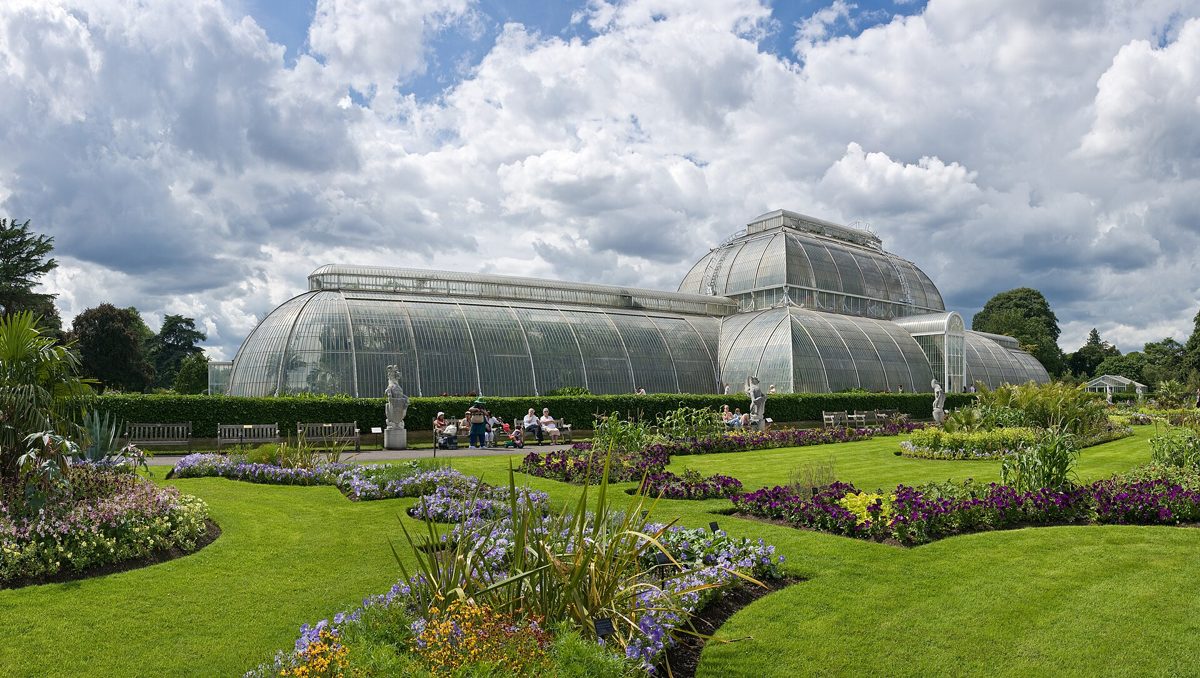
What it's for: Plant people, architecture admirers, and anyone who needs to be reminded that nature is the most imaginative designer. The Palm House, built in 1848, is a cathedral of Victorian ironwork filled with tropical species. The Temperate House, the largest surviving Victorian glasshouse, reopened in 2018 after a five-year restoration. The Treetop Walkway lifts you 18 metres into the canopy.
Seasonal notes: Bluebell season in the Natural Area (late April) is as good as any woodland in Britain. The Rhododendron Dell peaks in May. The Japanese Garden's cherries are best in March. Autumn colour in the arboretum is superb, and the glasshouses provide a warm escape on grey winter days.
Inside tip: At the far southern end, near the Brentford Gate, the Pagoda Vista is a long, straight avenue ending at the Great Pagoda, built in 1762. Most visitors never walk this far. The perspective is pure 18th-century landscape design, and the benches here are almost always empty.
Hampstead Heath
The Heath is London's wild heart: 320 hectares of ancient woodland, open meadow, and swimming ponds, all managed by the City of London Corporation under a 1871 Act of Parliament that guarantees it remains "unbuilt and unenclosed." It's not a polished Royal Park; it's a ragged common where the grass grows long and the paths are muddy in winter.
Character: Unruly, democratic, and deeply loved. The Parliament Hill viewpoint is the iconic London panorama, with the city's skyline arranged like a map. The three swimming ponds (men's, women's, and mixed) are open year-round for serious cold-water swimmers. Kenwood House, a Robert Adam neoclassical villa on the northern edge, holds a collection of Rembrandts and Vermeers that's free to view.
Seasonal notes: The bluebell woods near the Hill Garden in May are exquisite. Summer brings the bathing ponds into their own, with the mixed pond especially popular on hot afternoons. The autumn colour around Kenwood is rich and varied. Winter transforms the Heath into something bleak and beautiful, with the ponds steaming on cold mornings and the low sun cutting through bare branches.
Inside tip: Skip the main Parliament Hill viewpoint. Walk east to the second, lower hill near the bandstand. The view is nearly identical, and you'll find only locals who know the spot. Also: Kenay House has a decent café, but the real move is to bring a thermos and sit on the lawn facing the lake.
Hidden Gems - Chelsea Physic Garden and Garden Squares
Chelsea Physic Garden was founded in 1653 by the Worshipful Society of Apothecaries to study medicinal plants, making it the second oldest botanical garden in England after Oxford's. It's small, four acres tucked behind high walls on Swan Walk, and it contains roughly 5,000 species of edible, medicinal, and historically significant plants. The glasshouses hold the largest outdoor olive tree in Britain and a collection of citrus trees that recall the garden's role in early plant exploration.
Best for: Plant nerds, history buffs, and anyone seeking the quietest afternoon in Chelsea. The garden's microclimate, created by the high brick walls and riverside location, allows it to grow plants that wouldn't survive elsewhere in London. The snowdrop trail in January and February is a specific, lovely thing for winter-weary gardeners.
Inside tip: The café serves excellent cake and sits among the medicinal beds. Book ahead and arrive the first slot of the day; you'll have the place almost to yourself.
For garden squares, London has hundreds, but the grandest are in Bloomsbury and Kensington. Russell Square, laid out in 1800, has a café and generous lawns. Gordon Square and Tavistock Square are quieter, with plaques to the Bloomsbury Group writers who lived here. Most squares are open to the public during daylight hours, though some require a key if you're not a resident. The trick is to pick up a coffee from the nearest independent café and treat the square as your local garden.
Frequently asked questions
Which park is best for seeing the London skyline?
Primrose Hill and Parliament Hill on Hampstead Heath are the two classic viewpoints, both with protected sightlines to St Paul's Cathedral. Primrose Hill is more central and easier to reach, with a view that includes the London Eye and the Shard. Parliament Hill is higher and wilder, with a broader panorama that stretches from Canary Wharf to the suburbs. Both are best at sunrise or just before sunset.
Are the deer in Richmond Park dangerous?
The deer are wild animals, not pets. They are most aggressive during the autumn rut, usually September and October, and when they have calves in May and June. The park guidelines are simple: keep at least 50 metres away, never get between two deer, and never feed them or try to touch them. A stag can weigh over 150 kilograms and will charge if it feels threatened. The majority of incidents involve dogs off the lead or people attempting selfies.
When is the best time to visit Kew Gardens?
The best time depends on what you want to see. For bluebells and cherries, late April to early May. For roses and herbaceous borders, June and July. For autumn colour in the arboretum, mid-October to early November. For a warm, quiet escape from the city, any winter weekday morning, when the glasshouses are tropical and the gardens feel like your own. The first hour after opening is always the quietest, regardless of season.
This is an independent member's guide compiled by London BGTC Society. We are not affiliated with the venues and institutions mentioned; opening arrangements and programmes change - always confirm details on the official websites before making plans.
← Back to Events