London theatre beyond the West End - a member's guide
How to navigate London theatre like a local: the West End, the great subsidised houses and the fringe rooms where careers begin.
If you’ve ever stood in Leicester Square on a wet Tuesday evening, staring at a wall of neon-lit billboards and wondering where to actually put your money, you’re in good company. London’s theatre landscape is absurdly rich, but it’s also loud, fragmented, and full of people trying to sell you a jukebox musical as a life-changing event. This guide cuts through that noise. It’s not a ranking, not a calendar, and definitely not a list of “must-sees” that will date in six months. Think of it as a map of the territory - the institutions, the districts, the unspoken rules - written for someone who already knows they love theatre and wants to navigate the city with a bit more confidence.
The West End
The West End is not a theatre company or an artistic movement. It’s a geographical cluster of roughly 40 commercial theatres, most of them wedged between Shaftesbury Avenue, the Strand, and Charing Cross Road. These are privately owned venues - many of them Victorian or Edwardian - operated by producers who rent the house, mount a show, and hope it runs long enough to recoup. Architecturally, the buildings themselves are part of the draw: the gilded plasterwork of the Theatre Royal Haymarket, the domed ceiling of the London Coliseum, the cramped intimacy of the Duke of York’s.
Choosing a West End show is fundamentally different from choosing a show at a subsidised house. You’re shopping for a product, not engaging with an artistic policy. That’s not a criticism - some of the most electric nights I’ve had in London have been in commercial houses - but it helps to understand the logic. Long-running musicals (think Les Misérables, The Phantom of the Opera, Wicked) are the backbone, designed to fill 1,000-plus seats eight times a week for decades. Star-led straight plays have become their own mini-economy: a famous face in a classic or a proven modern hit, booked for a strictly limited 12- to 16-week run. The third category is the transfer - a production that started life at the National, the Almeida, or a fringe venue, got rave reviews, and gets a second life in a commercial house. Transfers are often your safest bet for quality, because the show has already been road-tested away from the commercial pressures of the West End.
Practical note: Day seats - a small allocation of tickets released in person at the box office on the morning of the performance, usually at a steep discount - are a West End staple. Not every show offers them, and the rules vary wildly: some require you to queue from 7am, others release them online at 10am sharp. Standing tickets are rarer but exist, typically sold only once the house is otherwise full. Both are worth investigating if your schedule is flexible and your budget isn’t.
The National Theatre
The National Theatre, on the South Bank, is the big beast of British subsidised theatre - three auditoriums (the Olivier, Lyttelton, and Dorfman) operating year-round, with a remit to produce classics, new writing, and large-scale work that commercial producers wouldn’t touch without a star attached. Architecturally, it’s the concrete Brutalist complex that people love to call ugly, though the riverside terraces and the ground-floor foyer - open all day, free to enter, full of people working on laptops - have made it a genuine public space.
Artistically, the National under Rufus Norris (and previously Nicholas Hytner) has swung between populist spectacle and formal experimentation. The Olivier, a vast fan-shaped auditorium with a drum revolve, is best suited to epic storytelling - think War Horse or the sprawling Angels in America revival. The Lyttelton is a more traditional proscenium arch, often home to new plays and mid-scale classics. The Dorfman is the studio space, a small rectangular room with flexible seating that has premiered some of the most formally inventive work in London - it’s where you go to see playwrights like Lucy Kirkwood or debbie tucker green work without compromise.
What to expect: a mix of heavyweight revivals (Shakespeare, Chekhov, Greek tragedy), new plays from established voices, and the occasional outright gamble. The National’s track record on new writing is uneven, but when it lands - The Inheritance, Network, Dear England - it shapes the wider conversation. The building also runs a sophisticated day-seat system: a batch of £10 tickets released online every Friday for the following week, plus a smaller number held for in-person sale each morning. The Friday drop is competitive; set an alarm.
Shakespeare’s Globe
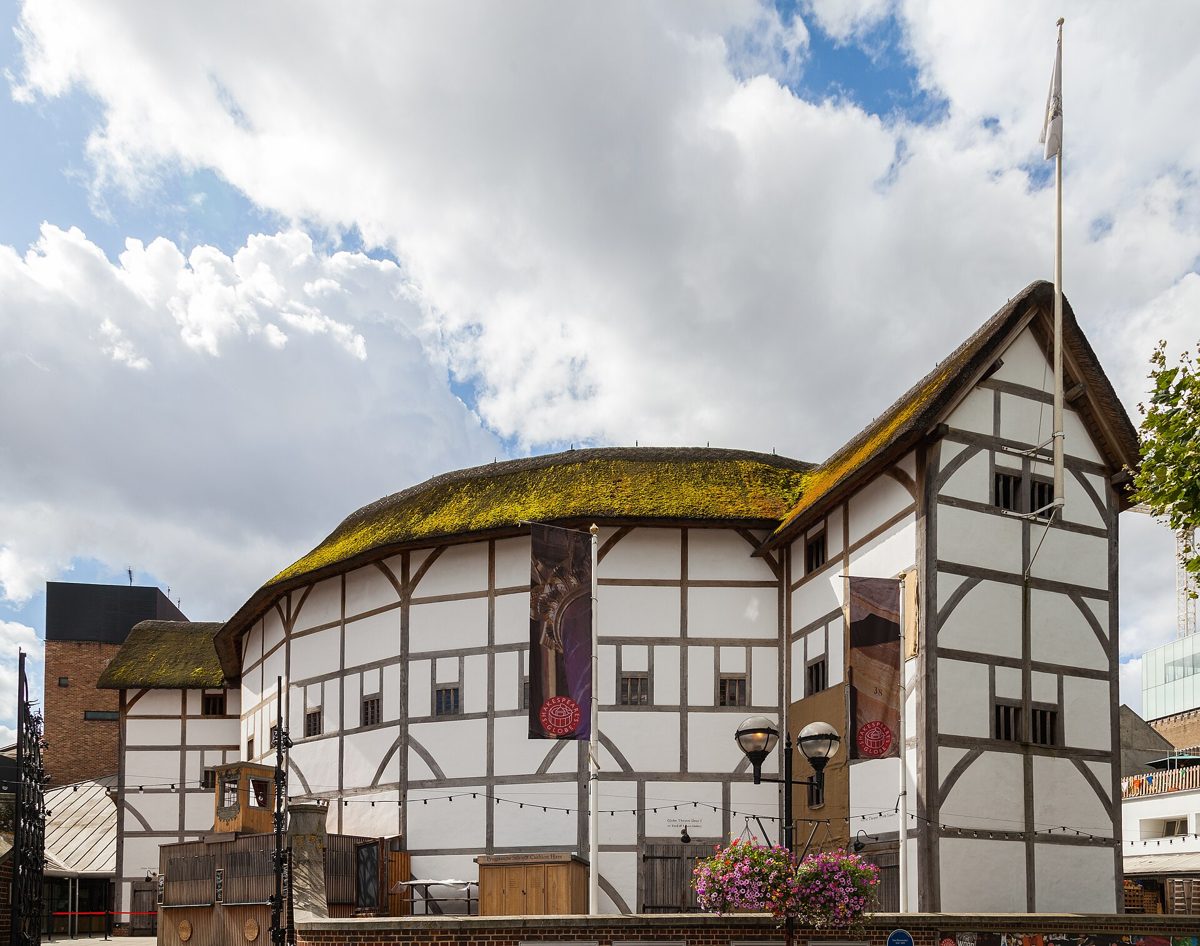
Shakespeare’s Globe, on Bankside, is a reconstruction of the 1599 open-air playhouse, built from oak and lime plaster roughly 200 yards from the original site. It’s not a museum. It programmes a full summer season of Shakespeare and early modern plays, plus occasional new work, in daylight and without microphones. The yard - where 700 people stand on the concrete floor, exposed to the sky - is the defining feature. If you haven’t stood in the yard for a performance, you haven’t really experienced what this building does.
The Globe’s artistic identity under Michelle Terry has leaned into radical clarity: stripped-back productions, often with minimal sets, that treat the text as the primary special effect. Gender-blind casting is standard. The house style prizes direct address to the audience over naturalistic illusion - soliloquies become conversations, and the groundlings become the crowd in the marketplace or the army on the battlefield. It can feel gimmicky when it misfires, but when it works, the connection between actor and audience is unlike anything in a darkened auditorium.
The season runs roughly April to October. The indoor Sam Wanamaker Playhouse, a candlelit Jacobean theatre tucked next door, operates year-round with a broader repertoire - Restoration comedy, chamber operas, winter Shakespeare. The Wanamaker is small, expensive, and often freezing, but the candlelight is not a gimmick: it changes how you watch.
Practical note: Yard tickets - effectively standing tickets - are £5 for every performance. You book them like any other seat. Bring a raincoat; umbrellas aren’t allowed because they block sightlines. The experience is physical. You will get tired. Do it anyway.
The Old Vic
The Old Vic, on the Cut near Waterloo, is an independent not-for-profit with a single 1,000-seat auditorium and a history that stretches back to 1818. It was the original home of the National Theatre company under Laurence Olivier, and later the fiefdom of Kevin Spacey - a chapter the institution has worked hard to move past. Under Matthew Warchus since 2015, the programming has coalesced around a particular sweet spot: emotionally direct, broadly accessible work that still has artistic credibility.
The Old Vic’s signature in recent years has been the Christmas show - Warchus’s own production of A Christmas Carol, which ran for multiple seasons and became a family ritual for a generation of Londoners. Beyond that, expect a mix of classic revivals (Present Laughter with Andrew Scott, King Lear with Glenda Jackson), new plays from writers with something to say but no interest in obscurity, and the occasional musical. The artistic policy is less intellectually confrontational than the Royal Court, less epic than the National. It’s a theatre that wants to fill its seats without dumbing down, and it mostly succeeds.
Practical note: The Old Vic runs a scheme called PwC £10 Previews, releasing a chunk of cheap tickets for the first few performances of every production. You need to sign up for their mailing list and act fast when the email arrives. It’s one of the best-value deals in London for a main-house show.
The Royal Court
The Royal Court, on Sloane Square, is the engine room of new British playwriting. Its remit is narrow and uncompromising: new plays, period. No classics, no musicals, no adaptations of beloved novels unless a playwright radically reimagines the material. The building has two spaces - the main Jerwood Theatre Downstairs (roughly 380 seats) and the smaller Jerwood Theatre Upstairs (a 90-seat studio) - and the Upstairs is where the real work happens. That tiny room has premiered early plays by Sarah Kane, Jez Butterworth, Lucy Prebble, and Alistair McDowall. It’s the closest thing London has to a laboratory for dramatic form.
The Royal Court’s identity is tied to a particular mode: the state-of-the-nation play, often set in a kitchen or a living room, often about class, money, or the slow rot of liberal pieties. That’s a caricature, but it persists because the Court has produced a century’s worth of plays that fit the description, from John Osborne’s Look Back in Anger to Caryl Churchill’s Top Girls to Alistair McDowall’s X. The current artistic director, David Byrne (not the musician), took over in 2024 and is still defining his tenure, but the institutional muscle memory is strong.
Expect to be challenged, occasionally baffled, and rarely comforted. The Royal Court does not do crowd-pleasers, and its strike rate isn’t 100% - but when a play hits here, it enters the repertoire. Jerusalem started at the Royal Court. So did The Ferryman.
Practical note: The Court offers a limited number of day seats for every performance, sold in person from 10am. There’s also a free script-reading scheme: pick up a copy of the play at the box office before the show, read it in the bar, return it afterwards. It’s a small gesture that says a lot about the institution’s priorities.
The Almeida
The Almeida, in Islington, is a 325-seat off-West End house that punches so far above its weight it’s basically in a different weight class. Under Michael Attenborough (2002–2013) and then Rupert Goold, it has become the most reliable producer of high-end, intellectually muscular theatre in London - the place where a director’s vision gets the space and budget to fully cohere before it transfers to the West End or Broadway.
The Almeida’s house style is hard to pin down because it’s director-driven rather than writer-driven. Goold’s own productions - a maximalist Richard III, a cold-sweat Macbeth, the astonishing Ink - set a tone of conceptual audacity, but the theatre also invites directors like Rebecca Frecknall, Robert Icke, and Carrie Cracknell to do their most ambitious work. Icke’s Oresteia and The Doctor, Frecknall’s Cabaret and A Streetcar Named Desire - these were Almeida productions first. If you want to see the show everyone will be talking about in six months, check what’s on here.
The building itself is a converted Victorian lecture hall, and the auditorium feels like a cockpit: tight, steeply raked, with excellent sightlines and an intensity that larger houses can’t replicate.
Practical note: The Almeida releases a small number of day seats online at 10am on the day of performance. They also run a scheme called “Almeida For Free” for under-25s, offering free tickets to select performances. Check the website for eligibility windows.
The Fringe Scene
“Fringe” in London doesn’t mean the Edinburgh Festival Fringe, though there’s some overlap. It means the decentralised network of small theatres - usually under 100 seats - scattered across the city, operating on shoestring budgets, often above pubs or in converted warehouses. This is where careers begin, where forms get broken, and where you’re most likely to see something that doesn’t exist in any other city.
The key venues shift over time, but a few have staying power. The Bush Theatre in Shepherd’s Bush is the most established fringe-adjacent institution - a dedicated new-writing theatre with a 144-seat main house and a smaller studio, responsible for launching writers like Arinzé Kene and Lenny Henry’s playwriting debut. The Finborough Theatre, above a pub in Earl’s Court, programmes forgotten classics alongside new work with a scholarly bent; its rediscoveries of neglected Victorian and Edwardian plays have been genuinely important. The Yard Theatre in Hackney Wick, built in a warehouse, leans into experimental form and electronic music. The New Diorama, near Regent’s Park, is an incubator for devised theatre companies. The Southwark Playhouse, with two spaces in Borough and Elephant & Castle, straddles fringe and off-West End with a programme that mixes musicals, classics, and new plays.
The fringe is where you learn to read a listing carefully. A show might be a student production, a scratch night of half-formed ideas, or a fully realised professional piece with a cast of Royal Court regulars. There’s no quality control beyond reputation and word of mouth. The upside is that tickets are rarely more than £20, and the intimacy of a 50-seat room can make a mediocre script feel alive in a way a bad West End show never does.
Practical note: Fringe venues rarely have formal day-seat schemes; prices are already low. Instead, look for preview performances - the first few nights of a run, often priced at a discount while the show beds in. The Yard and the Bush both do this systematically.
Frequently asked questions
How do I know which West End show is worth seeing right now?
Ignore the billboards and the TikTok hype. Read one review from a critic whose taste you’ve calibrated over time - if you don’t have one, start with Arifa Akbar in The Guardian or Matt Wolf in The New York Times - and one audience review from a friend who sees a lot of theatre. Transfers from the subsidised sector (National, Almeida, Royal Court, Donmar Warehouse) carry a quality signal because they’ve already survived an artistic process with no commercial safety net. Star casting can be a draw, but it can also paper over a weak production; check whether the director has a track record, not just the lead actor.
What’s the difference between the National Theatre and the Royal Shakespeare Company in London?
The National Theatre is a London institution that produces work year-round in its own building on the South Bank. The Royal Shakespeare Company is based in Stratford-upon-Avon but maintains a regular London presence, currently at the Barbican Centre. The RSC’s London transfers tend to be Shakespeare and early modern plays, often in productions that originated in Stratford. The National does Shakespeare too, but its remit is broader. If you want to see the RSC in London, check the Barbican’s theatre listings; the company typically transfers two or three productions a year.
Is it worth seeing theatre in London if I don’t want to spend £100 on a ticket?
Yes, and you almost never need to spend that much unless you’re set on premium stalls seats for a sold-out musical. Day seats, Friday rush schemes, preview discounts, and standing tickets cover most major venues. The Globe’s yard is £5. The National’s Friday rush is £10. The Royal Court’s day seats are under £15. Most fringe tickets are £12–20. The real barrier isn’t cost - it’s knowing the systems exist and being organised enough to use them. Sign up for venue mailing lists. Set alarms for ticket-release times. Be willing to queue. London theatre rewards people who treat it as a practice, not a one-off splurge.
This is an independent member's guide compiled by the London BGTC Society. We are not affiliated with the venues and institutions mentioned; opening arrangements and programmes change - always confirm details on the official websites before making plans.
← Back to Events